Radical Technologies
-OTHER
★★★★★
(2,095 ratings)  50,000+ Student

VLSI DESIGN AND FUNCTIONAL VERIFICATION

VLSI Design & Functional Verification training helps learners understand how digital chips are designed and tested for real-world applications. The course covers Digital Electronics, Verilog HDL, RTL Design, SystemVerilog, Functional Verification, and UVM. Through hands-on practice, debugging exercises, and projects, learners develop practical skills for the semiconductor industry and prepare for roles such as RTL Design Engineer, ASIC Design Engineer, and Design Verification Engineer.

RT
Radical Technologies
50,000+ English 26 weeks Weekdays / Weekends Classroom / Online / Corporate
Online / Classroom

VLSI DESIGN AND FUNCTIONAL VERIFICATION

IT Training Programme

Duration 26 weeks
Batch Type Weekdays / Weekends
Mode of Training Classroom / Online / Corporate
Locations Pune, Bangalore, Kochi
Language English
Certification Globally Recognized
Call Now

100% placement assistance

Enquire Now

Get course fees, batch dates & a callback

We never share your details.

What you'll learn

Understand core concepts and architecture from the ground up
Get hands-on with the tools used by working professionals
Build real-world projects you can add to your portfolio
Learn industry best practices and coding standards
Practice with real datasets and real-world scenarios
Prepare for certification and technical interviews
Work on collaborative, team-based exercises
Apply performance tuning and optimization techniques
Understand how the technology fits into a larger ecosystem
Complete assignments reviewed by mentors

Programme Overview

28 sections covering the complete curriculum — a single, progressive learning arc.

26 weeks
Training Duration
28
Core Modules
266
Total Lessons
4.7★
Average Rating
50K+
Students Trained
01

Foundations & Core Concepts

Get hands-on with the fundamentals and architecture — the building blocks for everything that follows.

Fundamentals Architecture Setup
02

Hands-On Practical Training

Work through real exercises and assignments designed to mirror what you will do on the job.

Practicals Assignments Labs
03

Real-World Projects

Apply what you have learned to end-to-end projects that go straight into your portfolio.

Projects Portfolio Case Studies
04

Advanced Techniques

Go beyond the basics with advanced concepts, integrations and production-grade practices.

Advanced Integration Best Practices
05

Ecosystem Integration

Understand how this technology connects with the broader tools and platforms used in the industry.

Ecosystem Tools Platforms
06

Performance & Interview Prep

Master optimization techniques and prepare for the technical interview questions employers actually ask.

Optimization Interview Prep Certification

Who is this programme for?

Whether you're already writing code, working with data, or supporting applications today — this programme is built to take you into a -OTHER role.

Software Developers

Engineers who want to add this skill set to their toolkit

Analysts & Consultants

Professionals moving into a more technical, hands-on role

IT Professionals

System admins and support engineers upskilling into a new domain

Fresh Graduates

CS/IT graduates aiming for a job-ready technical role

Course Curriculum

28 sections  •  266 lessons  •  26 weeks

01 1. Course Overview
This program is designed to build skills in digital hardware design and functional verificationfor the semiconductor industry. Students progress from digital logic fundamentals to RTLcoding, SystemVerilog testbench development, and UVM-based verification.
The program combines theory, hands-on EDA tool usage, debugging exercises, designassignments, verification projects, and job-oriented scenarios relevant to ASIC, SoC, and FPGA development.

Primary career tracks:

• RTL Design Engineer
• Digital Design Engineer
• ASIC Design Engineer
• Design Verification Engineer
• SystemVerilog Verification Engineer
• UVM Verification Engineer
• SoC Verification Engineer
02 2. Prerequisites
• Basic mathematics, including binary numbers and Boolean algebra.
• Basic computer operation and programming logic.
• Understanding of digital systems is helpful but not mandatory.
• Basic C programming or Python is beneficial for scripting, but not compulsory.
• Interest in semiconductor design, processors, embedded systems, or hardware verification.
03 3. Fundamentals
• Number systems: binary, decimal, octal, and hexadecimal.
• Signed and unsigned number representation.
• Binary arithmetic, complements, and overflow.
• Boolean algebra and logic simplification.
• Logic gates and truth tables.
• Combinational and sequential circuits.
• Multiplexers, decoders, encoders, and comparators.
• Latches, flip-flops, registers, and counters.
• Clock, reset, setup time, hold time, and propagation delay.
• Finite State Machines (FSMs): Moore and Mealy models.
• Introduction to integrated circuits, ASIC, FPGA, SoC, and the VLSI design flow
04 4. Core Technical Topics – Our Main Syllabus
Core Technical Topics – Our Main Syllabus
05 Module 1: Digital Electronics and Logic Design
30 hours
• Boolean algebra, Karnaugh maps (K-maps), and logic minimization.
• Combinational circuit design and optimization.
• Adders, subtractors, ALUs, multiplexers, encoders, and decoders.
• Sequential circuits, registers, counters, and shift registers.
• FSM design, state encoding, and transition tables.
• Timing diagrams, clock domains, reset strategies, and metastability fundamentals.
06 Module 2: Verilog HDL Programming
40 hours
Verilog syntax, modules, ports, parameters, and data
Nets, registers, vectors, constants, and
Continuous assignments using assign.
Procedural blocks: always, initial, and sensitivity
Blocking and nonblocking
Combinational and sequential logic
Conditional statements, loops, functions, and
Parameterized modules and structural
Testbench fundamentals, clock generation, reset sequences, and waveform
Simulation, synthesis-compatible coding, and common coding
07  

Details coming soon.

08 Module 3: RTL Design and Synthesis Fundamentals

45 hours

• RTL architecture, datapath and control-path design.
• FSM implementation and coding styles.
• Pipelining, latency, throughput, and resource sharing.
• Clock enables, synchronous and asynchronous resets.
• FIFO, counters, arbiters, and register-bank design.
• Synthesizable versus simulation-only constructs.
• Latch inference prevention and coding quality.
• Introduction to synthesis, technology mapping, and gate-level netlists.
• Static timing analysis (STA) fundamentals.
• Setup/hold violations, critical paths, timing constraints, and timing closure concepts.
• Clock-domain crossing (CDC) fundamentals and synchronizer design.
• RTL linting, design reviews, and basic power, performance, and area (PPA) awareness.
09 Module 4: SystemVerilog for Design and Verification
45 hours
• SystemVerilog data types, arrays, structures, unions, and enumerations.
• logic, bit, int, typedef, and parameterized types.
• Tasks, functions, packages, and interfaces.
• always_comb, always_ff, and always_latch.
• Classes, objects, constructors, inheritance, and polymorphism.
• Dynamic arrays, queues, associative arrays, and mailboxes.
• Events, semaphores, processes, and synchronization.
• Randomization, constraints, distributions, and inline constraints.
• rand, randc, and constraint-solving fundamentals.
• Functional coverage, covergroups, coverpoints, and crosses.
• SystemVerilog Assertions (SVA): immediate and concurrent assertions.
• Clocking blocks, virtual interfaces, and transaction-based testbenches.
10  

Details coming soon.

11 Module 5: Functional Verification and Verification Planning
30 hours
• Design specifications and verification planning.
• Test plans, test cases, corner cases, and requirement traceability.
• Directed, random, and constrained-random testing.
• Reference models and expected-result checking.
• Self-checking testbenches and scoreboards.
• Functional versus code coverage.
• Assertions, protocol checks, and error injection.
• Regression testing, failure triage, and bug reporting.
• Coverage gaps, verification completeness, and sign-off fundamentals.
12 Module 6: UVM-Based Functional Verification
50 hours
• UVM architecture, terminology, and class hierarchy.
• UVM test, environment, agent, and component construction.
• Sequence items, sequences, sequencers, and drivers.
• Monitors, agents, and virtual interfaces.
• Analysis ports, exports, FIFOs, and TLM communication.
• Scoreboards, reference models, and predictors.
• Factory registration, factory overrides, and configuration database.
• UVM phases, objections, and simulation lifecycle.
• Reusable agents and active/passive configurations.
• Virtual sequences and multi-agent coordination.
• Constrained-random stimulus and coverage-driven verification.
• UVM reporting, verbosity, debug, and regression automation.
• Reusable verification environments and industry-style testbench structure.
13 Module 7: Advanced Verification and Industry Workflow
30 hours
• Protocol verification concepts: APB, AHB, and AXI fundamentals.
• FIFO, memory-controller, bus, and register-interface verification.
• Assertions for protocol properties and temporal behavior.
• Functional coverage planning and coverage closure.
• Random-seed reproducibility and regression management.
• Waveform-based debug, transaction tracing, and failure analysis.
• Introduction to gate-level simulation and timing-aware verification.
• CDC/RDC verification concepts and lint-based checks.
• Version control, scripting, automated regression, and test reporting.
14 Module 8: Integration, Projects, and Interview Preparation

30 hours

• Integrating RTL modules and building verification environments.
• Design specification analysis and block-level verification planning.
• Debugging design and testbench failures.
• Code reviews, test-plan reviews, and coverage reviews.
• Project documentation and Git-based version control.
• Mock technical interviews, coding tests, and debugging rounds.
• Resume projects, technical explanations, and interview demonstrations.

Duration note: The module allocations above total 300 hours. Allow an additional 30–60 hours for extended labs, independent practice, or deeper project work to reach the recommended 300–360-hour delivery range.

15 5. Hands-On Labs
The following labs should be completed progressively, with simulation results and source code retained for review.

Lab Hands-on exercise

  • ›1 Logic gates and truth-table verification
  • ›2 Boolean expression simplification using K-maps
  • ›3 Half adder, full adder, and subtractor design
  • ›4 Multiplexer, decoder, and encoder implementation
  • ›5 Flip-flops, registers, and shift registers
  • ›6 Synchronous and asynchronous counter design
  • ›7 Moore and Mealy FSM implementation
  • ›8 Verilog combinational and sequential coding
  • ›9 Verilog testbench and waveform debugging
  • ›10 Parameterized ALU RTL design
  • ›11 FIFO RTL design and pointer management
  • ›12 Synthesizable RTL and latch-inference analysis
  • ›13 RTL synthesis and netlist inspection
  • ›14 Timing constraints and critical-path analysis
  • ›15 SystemVerilog arrays, structures, and packages
  • ›16 SystemVerilog OOP and transaction classes
  • ›17 Constrained-random stimulus generation
  • ›18 Functional coverage and coverage crosses
  • ›19 Assertions for counters, FIFOs, and FSMs
  • ›20 Self-checking testbench and scoreboard creation
  • ›21 UVM sequence item, sequence, and sequencer
  • ›22 UVM driver and monitor implementation
  • ›23 UVM agent and environment construction
  • ›24 UVM scoreboard and analysis-port integration
  • ›25 UVM factory and configuration database
  • ›26 UVM phases, objections, and test execution
  • ›27 UVM constrained-random regression
  • ›28 APB protocol verification
  • ›29 Coverage closure and regression failure triage
  • ›30 Capstone integration, verification, and final report
16 6. Assignments

Students should complete these assignments individually and submit code, test results, and brief technical documentation.

  • ›
  • ›1. Convert decimal values to binary, hexadecimal, and signed representations.
  • ›2. Simplify Boolean expressions and implement the optimized logic.
  • ›3. Design and verify a 4-bit ALU using Verilog.
  • ›4. Implement a parameterized up/down counter with reset and enable.
  • ›5. Develop an FSM-based traffic light controller.
  • ›6. Write a self-checking testbench for a register bank.
  • ›7. Implement a synchronous FIFO with full and empty flags.
  • ›8. Identify and fix inferred latches in RTL code.
  • ›9. Compare blocking and nonblocking assignment behavior.
  • ›10. Analyze setup and hold timing violations in sample timing reports.
  • ›11. Create SystemVerilog classes for packet and transaction generation.
  • ›12. Write constrained-random stimulus for a FIFO.
  • ›13. Build functional coverage for an ALU operation set.
  • ›14. Write assertions to check FSM transitions and FIFO behavior.
  • ›15. Develop a scoreboard for a memory or register interface.
  • ›16. Create a reusable UVM agent with driver, monitor, and sequencer.
  • ›17. Implement a UVM test using configuration settings and factory overrides.
  • ›18. Develop an APB transaction sequence and protocol checks.
  • ›19. Debug a failing constrained-random regression and document the root cause.
  • ›20. Prepare a coverage summary and verification sign-off report for a design block.
17 7. Mini Projects

Project 1: Parameterized ALU Design

Implement arithmetic and logical operations, status flags, and a self-checking Verilog testbench. Verify corner cases such as overflow and zero results.

Skills: Verilog, RTL, simulation

Project 2: Traffic Light Controller

Design a parameterized FSM with timer-based transitions, reset handling, and pedestrian request support. Validate state transitions using assertions.

Skills: FSM, sequential RTL, SVA

Project 3: Synchronous FIFO

Develop a configurable-depth FIFO with read/write controls, occupancy tracking, full/empty flags, and reset behavior. Verify simultaneous reads and writes.

Skills: RTL, corner-case analysis, scoreboards

Project 4: SystemVerilog Randomized Verification

Create transaction classes, randomized stimulus, constraints, functional coverage, and assertions for an ALU or FIFO.

Skills: SystemVerilog, OOP, SVA, coverage

Project 5: Reusable UVM Verification Agent

Build a reusable UVM agent with transaction sequences, driver, monitor, analysis connections, and a scoreboard. Run directed and randomized tests.

Skills: UVM architecture, reusable verification components

18  

Details coming soon.

19 8. Capstone Projects

These are larger projects suitable for a portfolio and technical interviews.

Capstone 1: RTL Design and Verification of a Synchronous FIFO

• Design a parameterized FIFO using synthesizable Verilog or SystemVerilog.
• Implement read/write pointers, occupancy, reset, and status flags.
• Create a SystemVerilog testbench and reference model.
• Verify boundary conditions, simultaneous read/write, and reset behavior.
• Add assertions and functional coverage.
• Produce simulation evidence, RTL documentation, and a verification report.

Capstone 2: UVM-Based APB Peripheral Verification

• Develop or use a simple APB-compatible peripheral RTL design.
• Create UVM sequence items, sequences, driver, monitor, agent, environment, and scoreboard.
• Verify register reads/writes, reset values, access timing, and invalid accesses as applicable to the specification.
• Add protocol assertions, constrained-random testing, and functional coverage.
• Run regression tests, analyze failures, close coverage gaps, and prepare a sign-off report.

Capstone 3: Mini-SoC Integration and Verification

• Integrate a simple control FSM, register bank, ALU, and memory interface.
• Define block-level and integration-level test plans.
• Verify reset sequencing, register transactions, data integrity, and control flow.
• Develop reusable verification components and a top-level testbench.
• Document bugs, fixes, regression results, and remaining verification limitations.
Expected deliverables: RTL source code, testbench/UVM environment, test plan, test results, waveform evidence, assertions, coverage reports, bug logs, and project documentation.
20  

Details coming soon.

21 9. Real-Time Job-Oriented Scenarios
RTL Development and Verification – Practical Job Scenarios
Sr. No. Job Scenario Practical Task
1 RTL Development Implement a register bank based on a design specification.
2 Design Optimization Reduce unnecessary logic while preserving functional behavior.
3 FSM Debugging Fix an invalid state transition or incomplete reset behavior.
4 FIFO Verification Detect data loss, duplication, or incorrect full/empty flags.
5 Timing Investigation Analyze a critical path and identify a possible timing bottleneck.
6 Reset Verification Validate reset assertion, release, and initialization behavior.
7 Randomized Testing Reproduce an intermittent failure using a recorded random seed.
8 Assertion-Based Verification Detect an illegal protocol transition using SystemVerilog Assertions (SVA).
9 UVM Development Add a new sequence and test to an existing verification environment.
10 Scoreboard Debugging Find mismatches between expected and observed transactions.
11 Protocol Verification Verify APB transfers, wait states, and error responses.
12 Regression Management Triage failures across multiple tests and identify common root causes.
13 Coverage Closure Identify untested functional scenarios and add targeted tests.
14 Design Integration Verify register maps, interfaces, and module interactions.
22 10. Troubleshooting Scenarios
1. Unexpected simulation output: Identify race conditions, incorrect event controls, orblocking/nonblocking assignment misuse.
2. Inferred latch: Find incomplete assignments in combinational logic and correct theRTL.
3. FIFO data mismatch: Check pointer updates, memory indexing, simultaneousread/write handling, and scoreboard timing.
4. FSM enters an illegal state: Review reset logic, state transitions, and recoverybehavior.
5. Simulation passes but synthesis fails: Identify unsupported constructs or simulationonly code.
6. Setup or hold violation: Interpret timing reports and investigate path delays,constraints, and clock relationships.
7. Random test fails intermittently: Re-run with the failing seed and trace transactionhistory.
8. UVM component receives no transactions: Check TLM connections, sequenceexecution, driver handshaking, and phase objections.
9. Scoreboard reports false mismatches: Investigate transaction ordering, samplingtiming, and reference-model assumptions.
10. Coverage remains low: Analyze uncovered bins and add meaningful stimulus ratherthan simply increasing test count.
11. Assertion failures: Verify assertion sampling, reset disable conditions, and theexpected protocol behavior.
12. Regression failures after a code change: Compare revisions, isolate the change, andexecute targeted regression tests.
23  

Details coming soon.

24 11. Industry Tools
The syllabus should include practical exposure to industry EDA tools. Access to commercial tools depends on institutional licenses; open-source tools can support many foundational labs.
EDA Tools and Their Usage in RTL Design and Verification
Sr. No. Tool Usage
1 EDA Playground Browser-based HDL simulation and experimentation.
2 Questa / QuestaSim Verilog and SystemVerilog simulation and debugging.
3 Synopsys VCS RTL and SystemVerilog verification simulation.
4 Cadence Xcelium Functional simulation and verification.
5 Verilator Fast HDL simulation, linting, and selected verification workflows.
6 Icarus Verilog Open-source Verilog simulation.
7 GTKWave Waveform viewing and debugging.
8 AMD Vivado FPGA RTL design, synthesis, implementation, and simulation.
9 Intel Quartus Prime FPGA design and implementation.
10 Synopsys Design Compiler Logic synthesis.
11 Cadence Genus RTL synthesis.
12 Synopsys Verdi Verification debugging and waveform analysis.
13 Cadence JasperGold Formal verification and property checking.
14 Git Source control and collaborative development.
15 Python and Make Regression automation, log parsing, and scripting.
Recommended tool strategy: Start with Icarus Verilog and GTKWave for foundational HDL labs, use a SystemVerilog-capable simulator for advanced verification, and use a licensed commercial simulator for UVM labs when available. Tool support for SystemVerilog and UVM varies by version.
25 12. Certification Names
There is no single universally required certification covering the entire Verilog-to-UVM pathway. Students can pursue relevant vendor certifications and training credentials alongside practical projects.
• IEEE Certified Software Development Professional (CSDP): Not a direct VLSI/RTLcredential; generally not a priority for this program.
• Siemens EDA training certificates: Relevant courses in Questa simulation andfunctional verification, depending on availability.
• Cadence training certificates: Relevant SystemVerilog, Xcelium, and UVM courses,depending on availability.
• Synopsys training certificates: Relevant VCS, Verdi, and functional verificationcourses, depending on availability.
• AMD FPGA training credentials: Relevant Vivado and FPGA design training,depending on the current program.
• Intel FPGA training credentials: Relevant Quartus and FPGA design training,depending on availability.
For this syllabus, vendor-specific SystemVerilog, UVM, and RTL design training certificatesare the most directly aligned options. Verify current course availability and whether acredential is a completion certificate or a formal certification before advertising it.
26 13. Mock Interviews

Conduct role-specific mock interviews with coding and debugging rounds.

Digital logic and Boolean algebra
Verilog coding and waveform
RTL design, FSM, FIFO, and timing
SystemVerilog OOP, randomization, constraints, and
SVA and protocol verification
UVM architecture, phases, sequences, drivers, monitors, and
Debugging exercises using failing simulations and
Project walkthrough, design decisions, and root-cause
27  

Details coming soon.

28 14. Recommended Learning Roadmap

M1

Month 1
Digital Electronics + Verilog
Logic design, HDL fundamentals, simulation, and basic testbenches.

M2

Month 2
RTL Design
FSMs, datapaths, FIFO, synthesis, timing, and design debugging.

M3

Month 3
SystemVerilog
OOP, constraints, randomization, assertions, and functional coverage.

M4

Month 4
Verification Fundamentals
Verification plans, self-checking testbenches, scoreboards, and protocol testing.

M5

Month 5
UVM
Reusable agents, sequences, drivers, monitors, scoreboards, and regressions.

M6

Month 6
Advanced Projects + Job Preparation
Capstone, coverage closure, debugging, technical interviews, and portfolio preparation.

Tools & Technologies

Every tool listed here is installed, configured and used in a hands-on lab session.

Core Tools

Hands-On Labs

Practical Environment

Industry-Standard Tools

Real-World Setup

Guided Exercises

Skill Building

Sample Datasets

Practice Material

Practice & Projects

Mini Projects

Applied Practice

Assignments

Mentor Reviewed

Doubt Sessions

Live Support

Career Readiness

Resume Building

Career Support

Mock Interviews

Interview Prep

Certification Prep

Global Recognition

Deployment & Delivery

Production Practices

Real-World Ready

Best Practices

Industry Standards

266+
Hands-On Lessons
28
Core Modules
26 weeks
Training Duration
100%
Practical Training

You don't just learn VLSI DESIGN AND FUNCTIONAL VERIFICATION. You ship it.

Three major projects, each mirroring how production teams actually work — from guided foundations to a portfolio-ready capstone.

PROJECT // 01

Guided Foundation Project

→Requirement Analysis

→Guided Implementation

→Mentor Review

→Iteration

Foundation Beginner

Apply the fundamentals in a structured, mentor-reviewed project

Take the core concepts from the first half of the curriculum and apply them to a realistic scenario, with guidance and feedback from your mentor at every step.

Structured project brief
Step-by-step implementation
Mentor feedback and review
Documented outcome
Stack Core Concepts Best Practices
PROJECT // 02

Applied Practice Project

→Scenario Design

→Independent Build

→Testing & Validation

→Peer Review

Applied Intermediate

Build a more independent project mirroring real production scenarios

Work through a project that combines multiple concepts from the curriculum, closer to how work is actually structured on the job — less hand-holding, more ownership.

End-to-end implementation
Testing and validation
Documentation
Peer/mentor review
Stack Applied Skills Testing
PROJECT // 03

Capstone Project

→Planning

→End-to-End Build

→Review & Refinement

→Presentation

Capstone Advanced

Take a project from requirements to a polished, portfolio-ready deliverable

Your final project — plan, build, test and present a complete solution using everything covered in the curriculum, reviewed by mentors before you graduate.

Complete working solution
Presentation-ready documentation
Mentor sign-off
Portfolio-ready deliverable
Stack Full Curriculum Portfolio

All 3 projects go directly into your portfolio & resume — reviewed by mentors before you graduate.

See Sample Project Reports

Upcoming Batches

No upcoming batches scheduled right now. Enquire to get notified.

Why Radical Technologies

Live Online Training
  • Highly practical oriented training
  • Installation support on your system
  • 24/7 Email and Phone support
  • 100% Placement Assistance
  • Global Certification Preparation
  • Trainer-Student Interactive Portal
  • Assignments and Projects by Mentors
Live Classroom Training
  • Weekend / Weekdays / Morning / Evening batches
  • 80:20 Practical and Theory ratio
  • Real-life Case Studies
  • Easy make-up for missed sessions
  • PSI | Kryterion | Redhat Test Centers
  • Lifetime Video Classroom Access (coming soon)
  • Resume Prep and Mock Interviews
Self-Paced Training
  • Learn 300+ courses at your own time
  • 50,000+ Satisfied Learners
  • Course Completion Certificate
  • Practical Labs available
  • Mentor Support available
  • Doubt Clearing Session available
  • 10% Discounted Global Certification

Like the Curriculum? Let's Get Started

Join 50,000+ students already enrolled at Radical Technologies

Enroll Now

Global Certification

Radical Technologies is the leading IT certification institute in Kochi, offering globally recognized certifications across various domains. With expert trainers and comprehensive materials, we ensure students gain in-depth knowledge and hands-on experience to excel in their careers. Our certification programs are tailored to meet industry standards — from cloud technologies to data science — empowering individuals to stay ahead in the ever-evolving tech landscape.
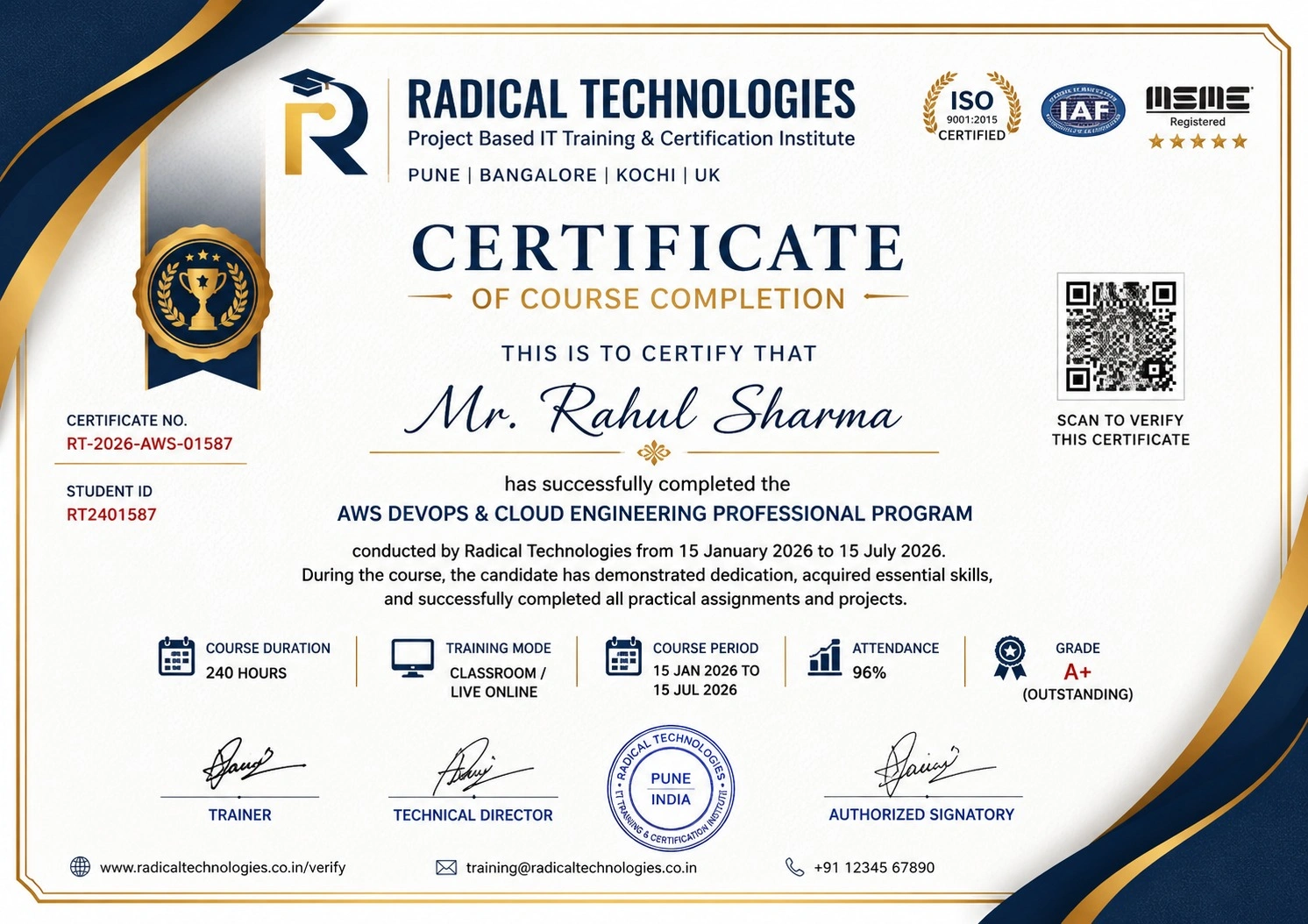
Certificate of Completion

Career Services

At Radical Technologies, we are committed to your success beyond the classroom. Our 100% Job Assistance program ensures that you are not only equipped with industry-relevant skills but also guided through the job placement process. With personalised resume building, interview preparation, and access to our extensive network of hiring partners, we help you take the next step confidently into your IT career.

Career Support

Course Completed? Need next steps?
Need Interview Supports?
Need Job Assistance?
Came from any other Institute?

Join our Brush-up Session & get support until you find a job!

Get Started

Radical Learning Eco-System

Exam Simulator

Cloud SandBox

Hands-on Cloud Lab

Developer Coding Ground

Student Reviews

4.7★
Average learner rating
50K+
Students trained
30+
Hiring companies alumni work at
100%
Placement assistance
4.7
★★★★★

Course Rating

★★★★★
79%
★★★★☆
16%
★★★☆☆
3%
★★☆☆☆
1%
★☆☆☆☆
1%

Our Alumni Work At

Accenture
Amazon
Avisys Services
Birlasoft
Capgemini
Catchpoint
Cognizant
Darwish Cybertech
DataVision
GiBots
Google
Groots Software
HCL Technologies
IBM
Info Gain
Infosys
ITCube Solutions
KPIT
L&T Infotech
Microsoft
Mphasis
mPhatek
Oracle
Quantbit Technologies
Saina Cloud
TCS
Tech Mahindra
Wipro
YASH Technologies
Zensar Technologies

VLSI Design & Functional Verification Course Certification with Training In Kochi

Get a Call Back from Our Career Assistance Team

Request Callback