
LINUX RHEL 8 & 9
Red Hat Linux Training Syllabus (Basic → Advanced) covering the topics of **Red Hat Enterprise Linux certifications such as Red Hat Certified System Administrator (RHCSA) and Red Hat Certified Engineer (RHCE). Covers each topics with Real Time Examples . Covers More than 250+ Real Time Scenarios which is divided into L1 (Basic) + L2 (Intermediate) and L3 (Advanced). Trainer from Real Time Industry. This is completely hands-on training ,which covers 90% Practical And 10% Theory. We give Combo Pack of RHEL 8 with RHEL 9 and RHEL 10 , to make sure all the candidate will get at least 5+ Year experience knowledge in Redhat Linux after attending this course. Covers SA1 + SA2 + SA3 topics in Details from the very basic to advanced level. Complete RHCSA and RHCE Exam Preparations.Appear for Redhat Global Certification Exam At any time After the course – No need to wait to get schedule from Redhat .At your convenient time , you can book and appear for exam using our Individual Exam Delivery System called KOALA
LINUX RHEL 8 & 9
IT Training Programme
100% placement assistance
Enquire Now
Get course fees, batch dates & a callback
What you'll learn
Programme Overview
41 sections covering the complete curriculum — a single, progressive learning arc.
Foundations & Core Concepts
Get hands-on with the fundamentals and architecture — the building blocks for everything that follows.
Hands-On Practical Training
Work through real exercises and assignments designed to mirror what you will do on the job.
Real-World Projects
Apply what you have learned to end-to-end projects that go straight into your portfolio.
Advanced Techniques
Go beyond the basics with advanced concepts, integrations and production-grade practices.
Ecosystem Integration
Understand how this technology connects with the broader tools and platforms used in the industry.
Performance & Interview Prep
Master optimization techniques and prepare for the technical interview questions employers actually ask.
Who is this programme for?
Whether you're already writing code, working with data, or supporting applications today — this programme is built to take you into a REDHAT LINUX | UNIX role.
Software Developers
Engineers who want to add this skill set to their toolkit
Analysts & Consultants
Professionals moving into a more technical, hands-on role
IT Professionals
System admins and support engineers upskilling into a new domain
Fresh Graduates
CS/IT graduates aiming for a job-ready technical role
Course Curriculum
41 sections • 329 lessons • 100 hours
Jump to Section
Total Duration
100 hours
100% Practical · Unlimited Doubt Sessions
01 Part 1: RHCSA (Red Hat Certified System Administrator)
02 Module 1: Linux Basics and Command Line Tools
Topics
Labs
Assignment
- ›Find files larger than 200MB and archive them into a backup file.
Job-Oriented Scenario
- ›A developer accidentally deleted logs.
- ›Recover compressed backup files from archive.
03 Module 2: User and Group Administration
Topics
Labs
Assignment
- ›Create users for HR, Finance, and IT departments.
Job Scenario
- ›A developer needs temporary administrative access.
- ›Configure secure sudo access.
04 Module 3: File Permissions and Access Control
Topics
Labs
Assignment
- ›Create shared project directory accessible by multiple teams.
Job Scenario
- ›Allow read access to one user without changing file ownership.
05 Module 4: Process Management
Topics
Labs
Assignment
- ›Write command sequence to identify top memory consuming process.
Job Scenario
- ›Production server is slow.
- ›Find process causing CPU overload.
06 Module 5: Package Management
Topics
Labs
Assignment
- ›Install web server packages from repository.
Job Scenario
- ›Server cannot access internet repository.
- ›Create local package repository.
07 Module 6: Storage Management (Important RHCSA Topic)
Topics
Labs
Assignment
- ›Create 10GB logical volume and mount permanently.
Job Scenario
- ›Database server storage is full.
- ›Extend logical volume without downtime.
08 Module 7: Networking Configuration
Topics
Labs
Assignment
- ›Configure two servers to communicate over network.
Job Scenario
- ›Users cannot access server due to incorrect network configuration.
09 Module 8: Firewall and Security
Topics
Labs
Assignment
- ›Allow web server traffic through firewall.
Job Scenario
- ›Application is running but users cannot access it due to firewall rules.
10 Module 9: SELinux Administration
Topics
Labs
Assignment
- ›Fix web server access issue caused by SELinux.
Job Scenario
- ›Application fails after SELinux policy enforcement.
11 Module 10: Log Monitoring and Troubleshooting
Topics
Labs
Assignment
- ›Identify reason for service failure using log files.
12 RHCSA Capstone Project
Enterprise Linux Server Deployment
Deliverables
13 Part 2: RHCE (Red Hat Certified Engineer)
14 Module 11: Introduction to Automation
Topics
Labs
Assignment
- ›Run commands on multiple servers using Ansible ad-hoc commands.
15 Module 12: Ansible Playbooks
Topics
Labs
Assignment
- ›Create playbook to install web server on multiple machines.
16 Module 13: Managing Files with Ansible
Topics
Labs
Assignment
- ›Deploy application configuration file to 5 servers.
17 Module 14: User Management with Ansible
Topics
Labs
Assignment
- ›Create 10 users across servers using playbook.
18 Module 15: Service Management with Ansible
Topics
Labs
Assignment
- ›Ensure web server service is running on all nodes.
19 Module 16: Ansible Roles
Topics
Labs
Assignment
- ›Create role for installing Apache web server.
20 Module 17: Advanced Ansible Automation
Topics
Labs
Assignment
- ›Automate full server configuration using playbooks.
21 RHCE Capstone Project
Automated Infrastructure Deployment
Deliverables
22 Part 1: Python for Linux System Administrators
Objective
23 Module 1: Introduction to Python (1 Hour)
Topics
Lab
Assignment
- ›Create a Python script that displays: CPU usage / Memory usage / Disk usage
24 Module 2: Python Basics for Automation (2 Hours)
Topics
Lab
Assignment
- ›Create a script that monitors disk space and alerts when usage exceeds 80%.
25 Module 3: File Handling and System Interaction (2 Hours)
Topics
Lab
Assignment
- ›Write Python script to: Check log files / Detect error messages / Generate report
26 Module 4: Automation Scripts for Linux Admins (2 Hours)
Topics
Mini Project
27 Module 5: Introduction to Cloud Computing (1 Hour)
Topics
Assignment
- ›Compare on-premise infrastructure vs cloud infrastructure.
28 Module 6: AWS Core Services (3 Hours)
Topics
Lab
Assignment
- ›Launch Linux web server on EC2.
29 Module 7: AWS for Linux Administrators (3 Hours)
Topics
Lab
Mini Project
30 Module 8: Introduction to DevOps (1 Hour)
Topics
Assignment
- ›Explain how DevOps improves software deployment speed.
31 Module 9: Version Control with Git (2 Hours)
Topics
Lab
Assignment
- ›Maintain automation scripts in Git repository.
32 Module 10: Containerization Basics (2 Hours)
Topics
Lab
Assignment
- ›Deploy web application inside Docker container.
33 Module 11: CI/CD Basics (1 Hour)
Topics
Lab
34 Final Mini Project
Linux DevOps Automation Project
35 Hands-on Labs
Intermediate
Advanced
36 Assignments
Intermediate
Advanced
37 Mini Projects
Intermediate
Advanced
38 Capstone Projects
Intermediate
Advanced
39 Troubleshooting Scenarios
Intermediate
Advanced
40 Best Practices
41 Latest Industry Topics
Tools & Technologies
Every tool listed here is installed, configured and used in a hands-on lab session.
Red Hat Enterprise Linux
Red Hat Satellite (Overview)
Red Hat Insights
Ansible Automation Platform
Podman
Buildah
Skopeo
Cockpit
Git
GitHub
GitLab
Jenkins
Docker (Comparison)
Kubernetes (Overview)
OpenShift (Overview)
Nagios
Zabbix
Grafana
Prometheus
VS Code
PuTTY
WinSCP
VMware Workstation
Oracle VirtualBox
Real-Time Job Oriented Scenarios
- New server deployment
- User onboarding
- Storage expansion
- Web server deployment
- Firewall configuration
- Backup implementation
- Log monitoring
- Service management
- Enterprise patch management
- Server migration
- Disaster recovery
- Production outage resolution
- Automation of repetitive administration tasks
- Linux hardening for compliance
- Large-scale Ansible automation
- Performance optimization
- Container deployment with Podman
- Hybrid cloud Linux administration
Skills You Will Gain
- Linux system administration
- Server troubleshooting
- Storage management
- Security configuration
- Automation using Ansible
- Infrastructure deployment
- Linux automation using Python
- Basic cloud infrastructure deployment
- Version control with Git
- Containerization with Docker
- Understanding of DevOps workflows
You don't just learn LINUX RHEL 8 & 9. You ship it.
Three major projects, each mirroring how production teams actually work — from guided foundations to a portfolio-ready capstone.
Guided Foundation Project
→Requirement Analysis
→Guided Implementation
→Mentor Review
→Iteration
Apply the fundamentals in a structured, mentor-reviewed project
Take the core concepts from the first half of the curriculum and apply them to a realistic scenario, with guidance and feedback from your mentor at every step.
Applied Practice Project
→Scenario Design
→Independent Build
→Testing & Validation
→Peer Review
Build a more independent project mirroring real production scenarios
Work through a project that combines multiple concepts from the curriculum, closer to how work is actually structured on the job — less hand-holding, more ownership.
Capstone Project
→Planning
→End-to-End Build
→Review & Refinement
→Presentation
Take a project from requirements to a polished, portfolio-ready deliverable
Your final project — plan, build, test and present a complete solution using everything covered in the curriculum, reviewed by mentors before you graduate.
All 3 projects go directly into your portfolio & resume — reviewed by mentors before you graduate.
See Sample Project ReportsUpcoming Batches
| Start Date | Time | Day | Mode | Enroll |
|---|---|---|---|---|
| 30/11/2026 | 08:00 AM – 09:00 AM | Weekday | Online | Enroll Now |
| 30/11/2026 | 05:00 PM – 06:00 PM | Weekday | Online | Enroll Now |
Why Radical Technologies
- Highly practical oriented training
- Installation support on your system
- 24/7 Email and Phone support
- 100% Placement Assistance
- Global Certification Preparation
- Trainer-Student Interactive Portal
- Assignments and Projects by Mentors
- Weekend / Weekdays / Morning / Evening batches
- 80:20 Practical and Theory ratio
- Real-life Case Studies
- Easy make-up for missed sessions
- PSI | Kryterion | Redhat Test Centers
- Lifetime Video Classroom Access (coming soon)
- Resume Prep and Mock Interviews
- Learn 300+ courses at your own time
- 50,000+ Satisfied Learners
- Course Completion Certificate
- Practical Labs available
- Mentor Support available
- Doubt Clearing Session available
- 10% Discounted Global Certification
Like the Curriculum? Let's Get Started
Join 50,000+ students already enrolled at Radical Technologies
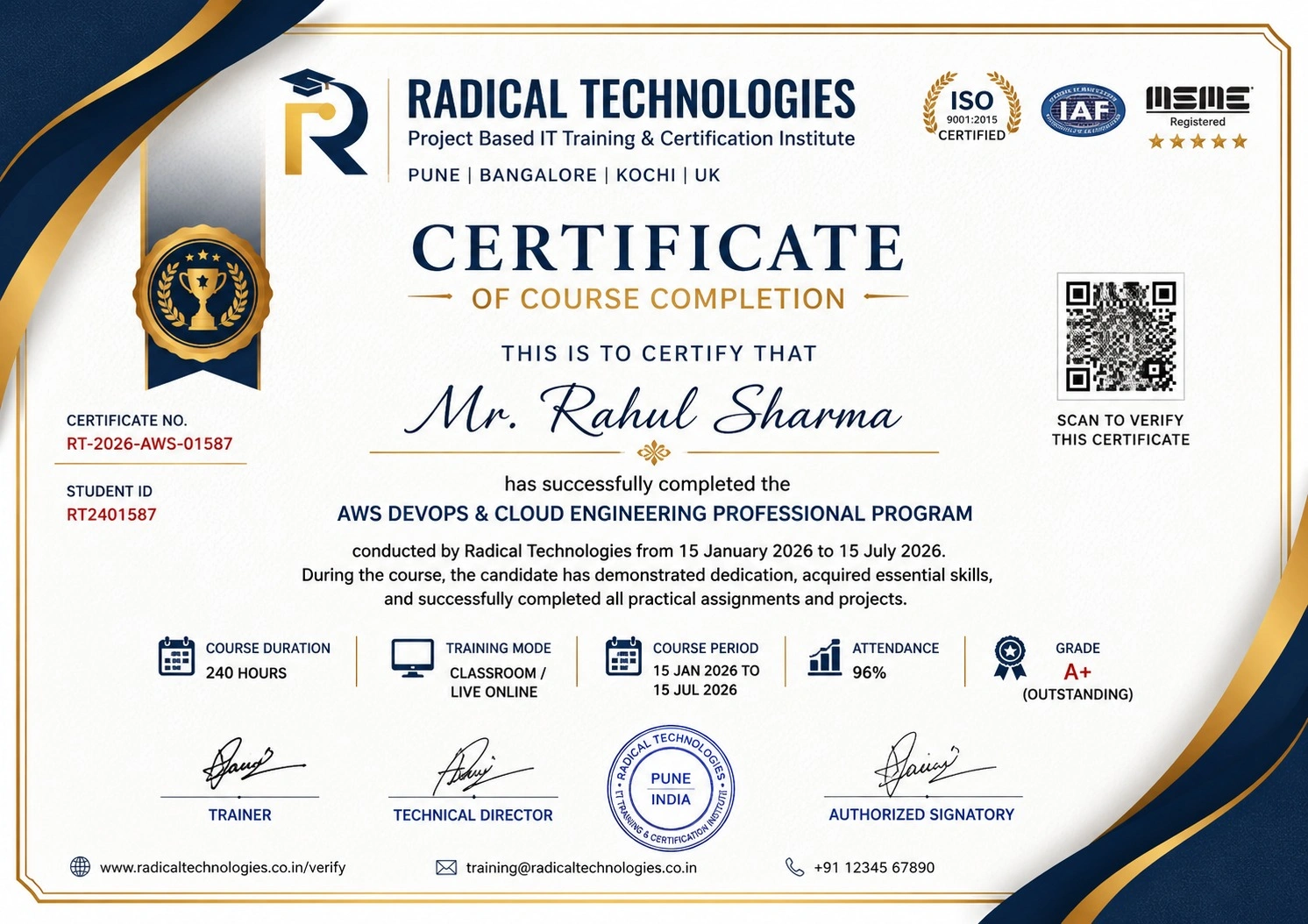
Global Certification
Radical Technologies is the leading IT certification institute in Bangalore, offering globally recognized certifications across various domains. With expert trainers and comprehensive materials, we ensure students gain in-depth knowledge and hands-on experience to excel in their careers. Our certification programs are tailored to meet industry standards — from cloud technologies to data science — empowering individuals to stay ahead in the ever-evolving tech landscape.
Recommended Certifications
Career Services
Our placement assistance program connects learners with opportunities through our network of 850+ hiring partners, including IT services companies, cloud consulting firms, product organizations, managed service providers (MSPs), system integrators, and enterprise infrastructure teams.
Placement Support Includes:
- Career counseling and skill-gap assessment
- Industry-oriented projects and lab experience
- Resume and LinkedIn optimization
- Technical, managerial, and HR mock interviews
- Communication and presentation skill enhancement
- Regular interview scheduling through our hiring partner network
- Guidance on certification planning, interview follow-ups, offer evaluation, and salary negotiation
- Continued placement assistance until candidates secure suitable employment, subject to individual performance, market conditions, and employer hiring requirements
Career Support
Join our Brush-up Session & get support until you find a job!
Get StartedCareer Opportunities
Radical Learning Eco-System
Exam Simulator
Cloud SandBox
Hands-on Cloud Lab
Developer Coding Ground
Student Reviews
Course Rating





Our Alumni Work At

















Linux Rhel 9 Course Certification With Training In Bangalore
Related Courses


LINUX RHEL 8 & 9 Course In Other Cities
Online Batches Available For These Areas
Ambegaon Budruk | Aundh | Baner | Bavdhan Khurd | Bavdhan Budruk | Balewadi | Shivajinagar | Bibvewadi | Bhugaon | Bhukum | Dhankawadi | Dhanori | Dhayari | Erandwane | Fursungi | Ghorpadi | Hadapsar | Hingne Khurd | Karve Nagar | Kalas | Katraj | Khadki | Kharadi | Kondhwa | Koregaon Park | Kothrud | Lohagaon | Manjri | Markal | Mohammed Wadi | Mundhwa | Nanded | Parvati Hill | Panmala | Pashan | Pirangut | Shivane | Sus | Undri | Vishrantwadi | Vitthalwadi | Vadgaon Khurd | Vadgaon Budruk | Vadgaon Sheri | Wagholi | Wanwadi | Warje | Yerwada | Akurdi | Bhosari | Chakan | Charholi Budruk | Chikhli | Chimbali | Chinchwad | Dapodi | Dehu Road | Dighi | Dudulgaon | Hinjawadi | Kalewadi | Kasarwadi | Maan | Moshi | Phugewadi | Pimple Gurav | Pimple Nilakh | Pimple Saudagar | Pimpri | Ravet | Rahatani | Sangvi | Talawade | Tathawade | Thergaon | Wakad
LINUX RHEL 8 & 9
IT Training Programme
100% placement assistance